I’m back to the wildflowers I found at the cemetery. It always amazes me the subtle color differences among the various “patches” of flowers. I feel like every row I walk down has a new group trying to stand out from the others. I guess the flowers are not so different from everyone else…
Speak to Me Olympus E-M1 Mark II, M. Zuiko 60mm f/2.8, 1/3200s, f/2.8, ISO 200
At times I am an opportunistic photographer, maybe all photographers are to a certain degree. The sky was blue most of the day and it was going to be a bright sunset. I wasn’t decided on where I should go to catch the last of the light when I noticed the yard had dandelions starting to seed. Well, that changed everything.
The macro lens was still on the camera and there were pockets of sunlight streaking through the trees. I didn’t have to give it a second thought… yard exploring it was! I can imagine my fellow residents of the apartment complex were curious as to why this mad man was crawling around the yard on his knees photographing the weeds. 🙂
This image was the first subject I found. I loved the look of one seed caught while trying to escape. The wind was not quit enough to allow it its freedom. Patience rules as it awaits the next strong breeze…
Escape Olympus E-M1 Mark II, M. Zuiko 60mm f/2.8 Macro, 1/125s, f/2.8, ISO 200
My trip to the cemetery the other day was very fruitful, photographically, so why not an image that resembles grapes. I’ve posted a few images of these little wildflowers before. The image does nothing the relay their actual size, which, is quit small. A large bloom could be 1.5 – 2″ in height.
Years ago when I first found these little gems I did think they looked like grapes. A quick search on the internet revealed the following:
Muscari is a genus of perennial bulbous plants native to Eurasia that produce spikes of dense, most commonly blue, urn-shaped flowers resembling bunches of grapes in the spring. The common name for the genus is grape hyacinth, but they should not be confused with hyacinths.
I am admittedly clueless when it comes to flowers but I do know what I like to photograph. Each year I can’t wait for these little guys to bloom and the section of the cemetery where they sprout up is starting to get crowded. I’m hoping for a little sun today so I can return to see if any others would like their portrait captured…
Muscari Olympus E-M1 Mark II, M. Zuiko 60mm f/2.8 Macro, 1/1250s, f/2.8, ISO 200
Pixley Falls State Park Chittenango Falls State Park
I love photographing water. It presents many possibilities that I am unable to ignore. I am also entranced by the sounds of running water and could sit for hours listening to it. I even have a babbling brook soundtrack I play at night that puts me to sleep within minutes.
While I was at Pixley Falls State Park over the weekend I not only captured images of the waterfall, I searched the creeks feeding the falls for isolated mini falls. The morning had progressed enough and allowed the sun to find such a small section of the creek. I played for quite some time trying different angles and compositions. I really loved this almost macro view with the golden sun reflected in the water.
Gold Flow Olympus E-M1 Mark II, M. Zuiko 12-40mm f/2.8, 0.6s, 34mm, f/8, ISO 200
Although I love the waterfalls at Chittenango Falls State Park there is a section of the creek above the falls that is an amazing playground for me. Depending on the time of year and the volume of water flowing through the creek I can lose time exploring every twist, turn and mini waterfall I can find. It also is a lesser explored area of the park and I encounter far fewer people… 😉
I’m lucky enough to have a spot where an outcropping of stone allows me to practically be in the creek to capture the water. The volume was heavy and the water was flowing fast over the weekend as evidenced by the early picture of the main waterfall. I almost converted this image to B&W, which is my go-to process for this type of image. I couldn’t bring myself to use that version, I really liked the changing colors in the turbulent areas of the creek.
Hasten Olympus E-M1 Mark II, M. Zuiko 12-40mm f/2.8, 1/8s, 35mm, f/11, ISO 200
It was almost too windy to go on a hunt for flowers. I had my doubts I would be able to capture good images while the flowers swayed back and forth. I wasn’t particularly excited by the thought of staying inside another day. After the snow we received on Saturday, I wanted to get out and see some color. I didn’t care if I came home empty handed, at least I would get outside.
I started at my favorite location to find the little wildflowers I typically photograph, the Wright Settlement Cemetery. I have been waiting for the grape hyacinth, and the small white, purple and pink little flowers to take hold in the grass. The first to bloom are the daffodils and then a few weeks later I can capture the little ones fighting with the grass. The snow did not frighten them away…
Let Me Shine Olympus E-M1 Mark II, M. Zuiko 60mm f/2.8 Macro, 1/1600s, f/2.8, ISO 200
After capturing my images at the cemetery I drove through the city looking for other possibilities. I spotted the tulips along the meridian on Black River Boulevard. I will need to come back when the wind is not as strong, those tall blossoms definitely were dancing to much. I Also spotted some flowering shrubs at Franklyn’s Field. Another possible destination. It appeared as if the city had started planting the flowers but still had more to do. I’ll wait, the colors will be worth it…
I mentioned in my ‘…as the sun goes down‘ post, before the sun was in its best position I ran around the water’s edge grabbing long exposure images. Sadly, I realized when I went to process those images that my 10-stop ND filter has a small scratch on it. This creates a very visible sun spot when shooting into the sun.
Sadly, as I researched getting a replacement it appears I bet on the wrong horse. I bought a set of square ND filters with a holder capable of installing a circular polarizer from Vu Filters. I have been very happy with the results. Because I use a micro four thirds system with smaller lenses I did not need big filters and Vu had a 75mm wide system that would be great for all my lenses. Doing a little research, it appears Benro bought out Vu and incorporated the filters into their own line. Hopefully, I can get a replacement without having to switch do a different system.
Luckily, for you I was able to salvage one image from my ruined long exposure fun. I found a grouping of rocks at the edge of the water to use as foreground interest for the color show happening at the horizon. With the clouds partially obscuring the sun combined with 10-stops of light filtering I captured a 30 second exposure. This long exposure smoothed out what little waves were undulating on the water and created a glass-like look reflecting the colors in the sky.
I did minor tweaking to the image in Lightroom sticking with a few adjustments to highlights and shadows. I then processed it in Luminar to enhance the colors, mainly to bring out the blues and brighten the oranges. Add a subtle vignette and the image is ready for display…
Color on Glass Olympus E-M1 Mark II, M. Zuiko 12-40mm f/2.8, 30s, 12mm, f/11, ISO 100
In a previous post I mentioned my adventure at Chittenango Falls State Park earlier this week. The volume of water flowing over the falls was incredible. I generally like to photograph the falls when the amount of water allows me to highlight the cascades. The silky streams of water mesmerize me. I wasn’t sure how the pictures would turn out with this much water but I have to admit I am happy with the result.
Setting up for the image I was worried the highlights in the water would cause me issues, especially having to expose enough for the gorge walls still in shadow. I countered by using my polarizing filter which helped reduce the glare and allowed me to capture this image with one exposure. In the past, as I was beginning to learn, I relied on high dynamic range (HDR) techniques to create my images. When done correctly, the HDR technique can yield amazing results, but I used it as a crutch and at times I ended up washing out an image. I was creating images without a proper balance of light and shadow. You need good shadows to produce an interesting image (IMO).
Considering how bright the sun was shining I threw on my 4-stop ND filter as well to reduce my shutter speed and achieve the blur I wanted in the water. Due to the speed of the water flowing through the creek I did not have to get below 1 second to achieve the my look. This is another area that is subjective to the photographer but I like to be able to see the water flowing. I try not to reduce my shutter so far as to create only a blur of white to represent the water but I also do not want to freeze the water with to fast of a shutter.
This park and the beautiful cascading waterfall is one of my favorite places to go in Central NY…
Roaring Falls Olympus E-M1 Mark II, M.. Zuiko 12-40mm f/2.8, 1/5s, 21mm, f/11, ISO 200
As they say, ‘Even a blind squirrel finds an acorn once in a while’, which would describe Thursday morning appropriately. All week I have been going out before work to find a sunrise. Yesterday, as I stepped outside to place the latest recyclables in the bin for collection, I couldn’t help but notice the full moon. My initial plan to head toward Utica for a sunrise was immediately changed to ‘can I capture the moonset?’
Checking the Photographer’s Ephemeris I see that the sun will rise at 5:48am and the moon will set at 6:08am. The best location for the show would be Delta Lake State Park. There were a few clouds in the sky and the moon was beginning to be obscured but working with my new attitude of ‘you have to be in the environment to capture the landscape’, I headed off for the park.
It was a cool, calm morning and being at the water’s edge waiting on the moon was totally worth it. Not another person in sight. I could hear ducks and geese out on the lake and the clouds were moving in the right direction. What a way to start the morning!
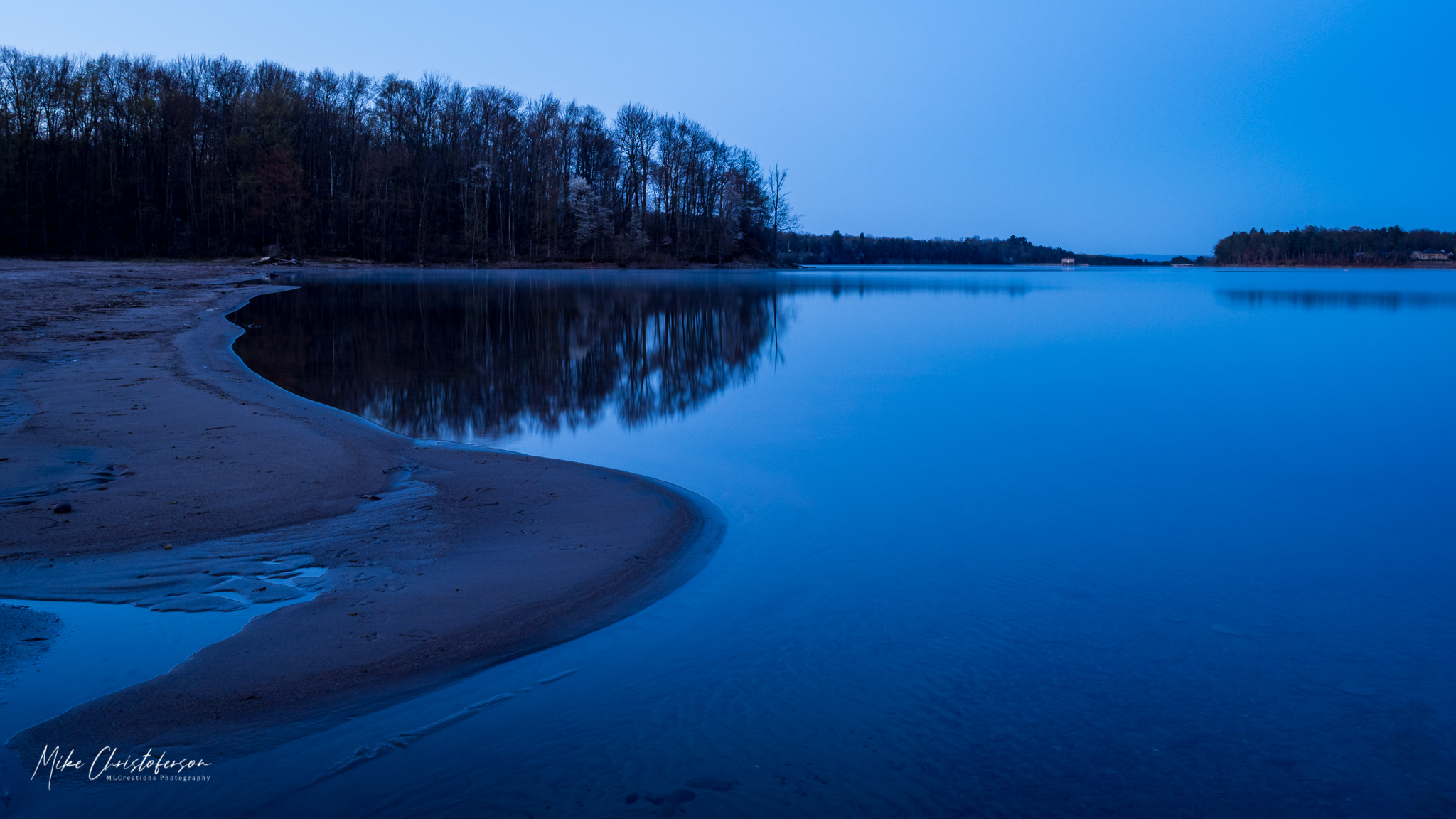
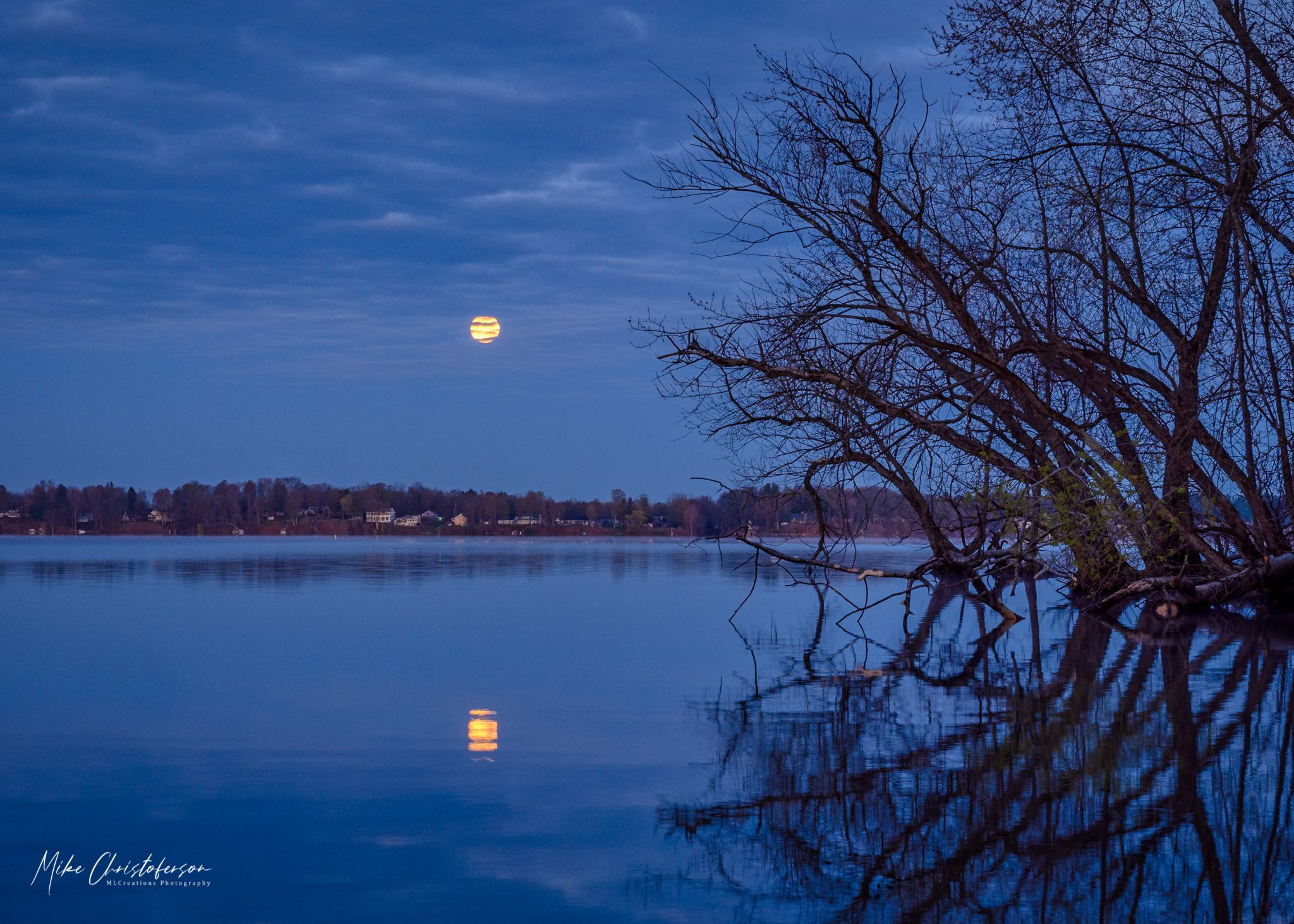
The first two images were my view of the lake as I arrived at the park. I knew the moon was out there behind the clouds… be patient, don’t call it a day yet!
Flower Moon I Olympus E-M1 Mark II, M. Zuiko 12-40mm f/2.8, 6s, 12mm, f/11, ISO 200
Flower Moon II Olympus E-M1 Mark II, M. Zuiko 12-40mm f/2.8, 3.2s, 15mm, f/11, ISO 200
I initially setup the camera at the edge of the beach. After standing there for five to ten minutes I realized I wanted to isolate the trees on the point in my composition. I walked around to the right of the beach and found a nice big rock under a tree on the water’s edge. This allowed for a ‘cleaner’ view and would allow the moon to stand out more in the image (when it finally quit hiding in the clouds).
Flower Moon III Olympus E-M1 Mark II, M. Zuiko 12-40mm f/2.8, 1/6s, 36mm, f/11, ISO 200
Flower Moon IV Olympus E-M1 Mark II, M. Zuiko 12-40mm f/2.8, 1/10s, 40mm, f/11, ISO 200
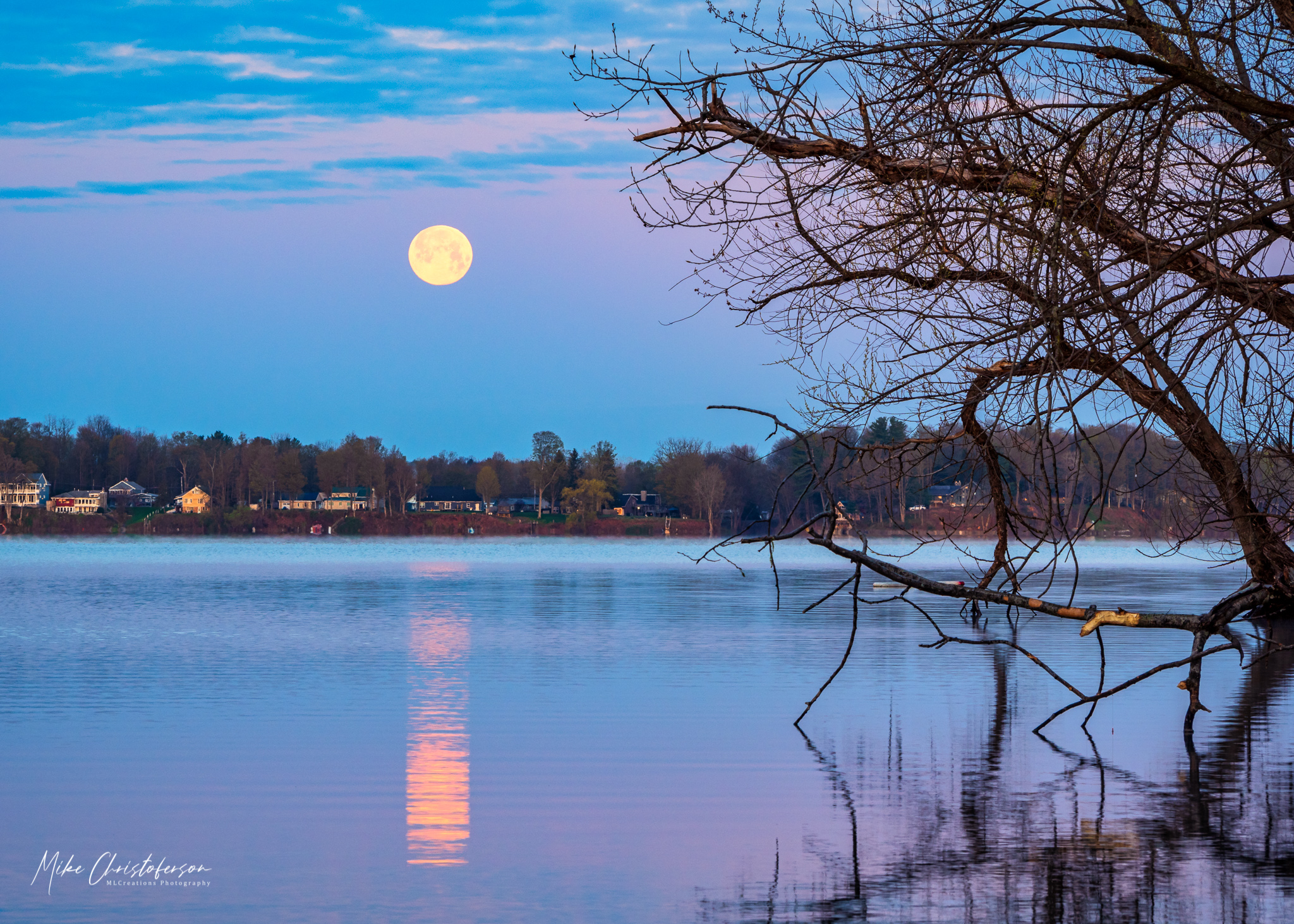
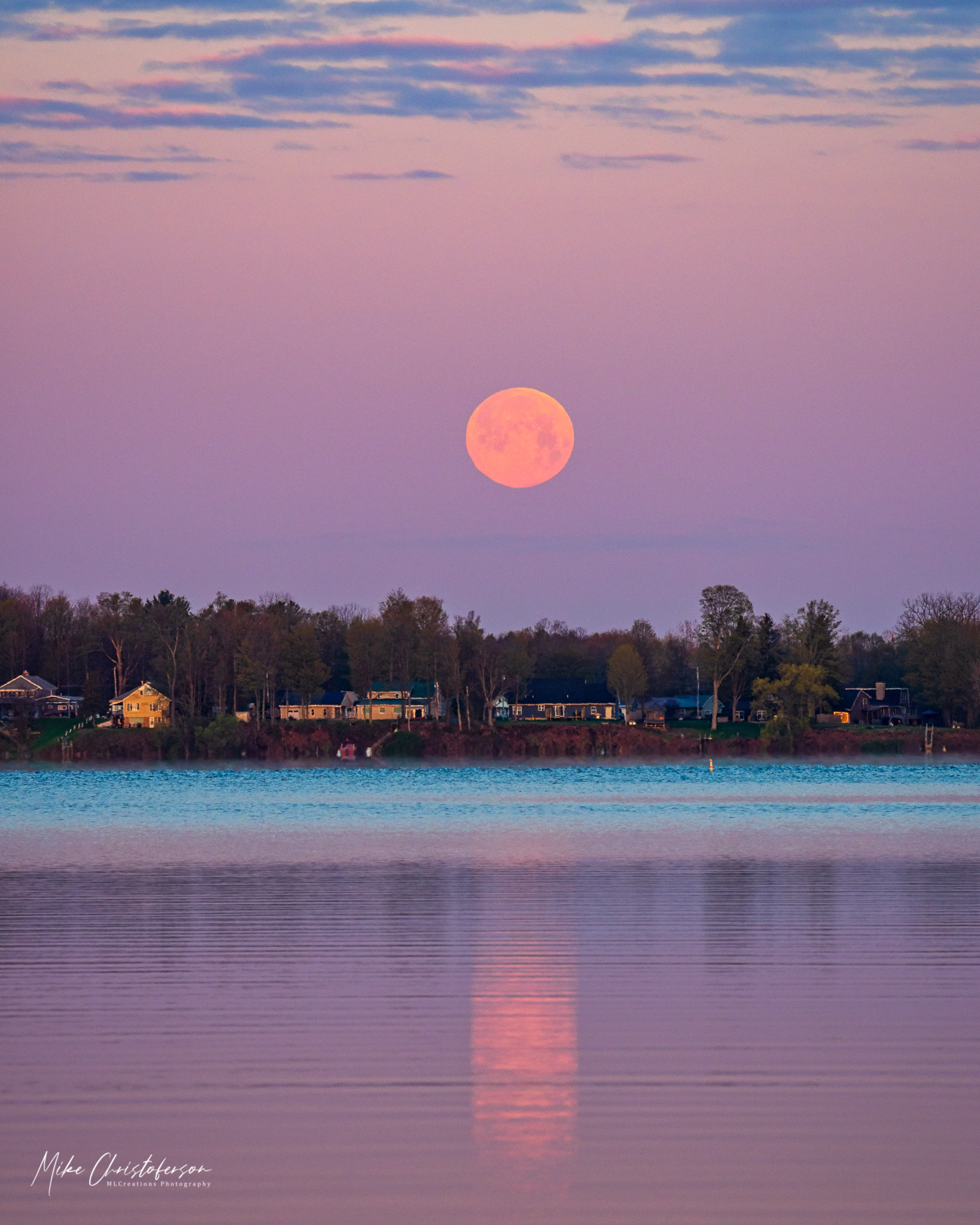
It was after the last capture I realized to truly emphasize the moon I needed a longer lens. Switching to the 40-150mm telephoto lens I was able to bring the moon larger into the image. By the last two images the sun was above the horizon and throwing lots of color into the western sky. It was a great way to end my adventure and I was totally charged for the day ahead of me.
Flower Moon V Olympus E-M1 Mark II, M. Zuiko 40-150mm f/4-5.6 R, 1/13s, 85mm, f/11, ISO 200
Flower Moon VI Olympus E-M1 Mark II, M. Zuiko 40-150mm f/4-5.6 R, 1/30s, 150mm, f/11, ISO 200
It wasn’t until later in the day that I learned this was the last ‘super moon’ of 2020. I also learned it is called the ‘Flower Moon’. Digging into the name a little more I found you can also call the full moon in May the ‘Corn Planting Moon’, the ‘Hare Moon’, and the ‘Milk Moon’. On the Full Moon Phases website I also picked up this bit of information…
Full Moon names have been used by many cultures to describe the full moon throughout the year. Specifically, Native American tribes used moon phases and cycles to keep track of the seasons by giving a distinctive name to each recurring full moon, including the Wolf Moon. The unique full moon names were used to identify the entire month during which each occurred.
Although many Native American tribes gave distinct names to the full moon, the most well known full moon names come from the Algonquin tribes who lived in the area of New England and westward to Lake Superior. The Algonquin tribes had perhaps the greatest effect on the early European settlers in America, and the settlers adopted the Native American habit of naming the full moons.



 MLCreations Photography